Where did it all start?

Between the 8th and 13th centuries, scholars, scientists, doctors, and philosophers like Al-Zahrawi, ibn Sina, and ibn Hayyan worked endlessly to discover knowledge that they would be the first in the world to come upon. During this time, the West was struggling with economic and cultural damage with no discoveries or scientific advancements – a period known as the Dark Ages. For the Islamic civilizations, however, came the Golden Age.

The period of time when most of the major discoveries and inventions were being made by Muslims is known as the Golden Age. This was a period of time when Muslim scholars, but also scholars of different faiths, expanded the knowledge of ancient Egypt, Mesopotamia, Persia, China, India, and other nations, which would later pave the way for the European Renaissance (Al-Hassani, 19). During the Golden Age, the most successful years were those under the rule of the Caliph Al-Mamun (Massoud, 55). He promoted science more than any other caliph and encouraged investments to be made into new scientific knowledge. This is proven by the fact that he once he obtained victory against the Byzantines, he asked for nothing but a copy of Ptolemy’s book of astronomy, the Almagest, and turning down gold or valuables (Massoud, 56). Contrary to popular belief, important figures who were strong advocates of expanding knowledge existed in the Muslim world too, as seen here by Al-Mamun. Academies such as the House of Wisdom were also founded to provide a space for Muslim, Christian, and Jewish scholars to translate knowledge of Hippocrates and Aristotle and encourage new scientific discoveries (Al-Hassani, 18). 
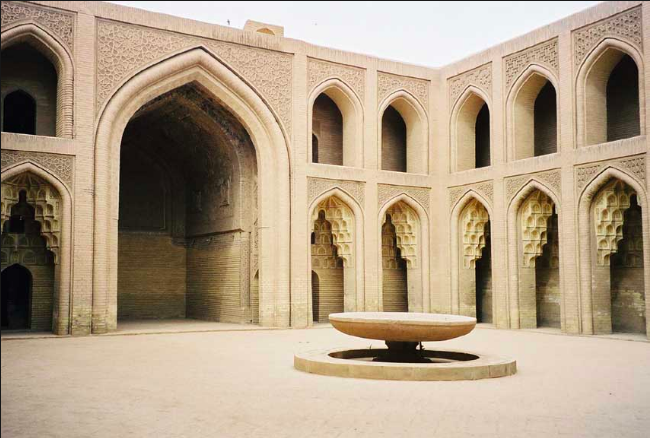
Image of the House of Wisdom in Baghdad, Iraq. It is also known as The Grand Library of Baghdad. It was a place of vast knowledge and wisdom during the Golden Age, and home to many discoveries that would go on to become foundations of modern, Western science.
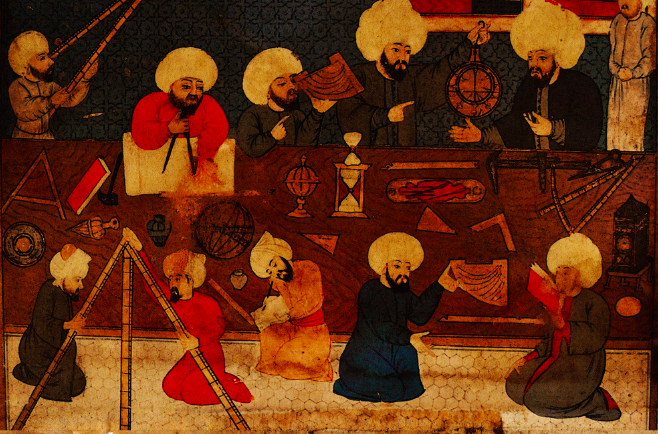
Dark Ages on one side of the world and Golden Ages on the other

Beginning in the 7th century and continuing rapidly onward, especially when the West was struggling in many aspects during the Dark Ages1, the Muslim civilization was progressing rapidly. While the West was struggling and in a period of drawbacks, Muslims were making large, influential scientific and cultural developments (Al-Hassani, 6). All of the new discoveries in the Islamic world were flourishing and they were contributing to the European Renaissance. The unfortunate reality, however, is that many accept the idea that inventions and discoveries just appeared during the Renaissance “as if by miracle” (Al-Hassani, 10). Because the West has so much misunderstanding about Islam in general, many Westerners ignore the great influence Muslim figures had on Western culture and civilization (Al-Hassani, 10). 

1 – A historical period in which the Western world suffered demographic, cultural, and economic collapse after the decline of the Roman Empire. It was a stagnant period of no discoveries or advancements. The years of great Muslim advancements and conquests.

The period of time when most of the major discoveries and inventions were being made by Muslims is known as the Golden Age. This was a period of time when Muslim scholars, but also scholars of different faiths, expanded the knowledge of ancient Egypt, Mesopotamia, Persia, China, India, and other nations, which would later pave the way for the European Renaissance (Al-Hassani, 19). During the Golden Age, the most successful years were those under the rule of the Caliph Al-Mamun (Massoud, 55). He promoted science more than any other caliph and encouraged investments to be made into new scientific knowledge. This is proven by the fact that he once he obtained victory against the Byzantines, he asked for nothing but a copy of Ptolemy’s book of astronomy, the Almagest, and turning down gold or valuables (Massoud, 56). Contrary to popular belief, important figures who were strong advocates of expanding knowledge existed in the Muslim world too, as seen here by Al-Mamun. Academies such as the House of Wisdom were also founded to provide a space for Muslim, Christian, and Jewish scholars to translate knowledge of Hippocrates and Aristotle and encourage new scientific discoveries (Al-Hassani, 18). 

(1001inventions.com)

Different fields of science that Muslims contributed to & their inventions

Muslims were influential in a variety of fields of science, ranging from chemistry, biology, physics, psychology, to even medicine. The Muslim civilization between 800-1600 was home to doctors who studied the human body and its intricacy in order to find new cures for disease, brilliant astronomers who discovered stars and introduced the possibility of space travel, physicists who studied the laws of gravity, and chemists who were discovering groundbreaking experimental methods (Al-Hassani, 15). One experimental method in chemistry, known as distillation, is very important in the synthesis of products such as plastics, gasoline, oils, and other important materials, and was first perfected by a Muslim (Al-Hassani, 14). Other Muslim figures continued to make discoveries that made the understanding of certain phenomena in biology, physics, chemistry, and medicine possible. 

Each and every day, intelligent scholars and scientists around the world and especially in the West are working to solve some of the most mysterious phenomena of mankind. Many of the discoveries scientists are working toward today are only possible because of the staple Muslim inventions. In the world of medicine around the year 1000, a Muslim doctor, Al-Zahrawi, published a 1500 page encyclopedia that contained illustrations of surgery and was used in Europe for the next 500 years. Al-Zahrawi also was said to have discovered the use of dissolved cat gut to stitch wounds and was also said to perform the first cesarean section surgery (CNN). Known as “The Father of Modern Surgery”, Al-Zahrawi also invented the first pair of forceps, a crucial instrument used in surgeries even today, to remove a bladder stone during an operation (Elgohary, 85). In Iraq, Jabir ibn Hayyan was busy laying the foundations for chemical principles, about 900 years before Robert Boyle, the so-called  Irish “Pioneer of Modern Chemistry”, was revealing many of the building blocks of chemistry to the rest of the world (Science History Institute). Ibn-Sina was a wise Muslim man, who in his The Book of Healing, discussed how clouds form, the source of water, how mountains come to be, and the possible cause of earthquakes (Al-Hassani, 170). Many of the books Ibn-Sina published on the topic of medicine, physics, philosophy, and even geology became prized sources of study in Europe and the knowledge was spread (Khalil Center). 

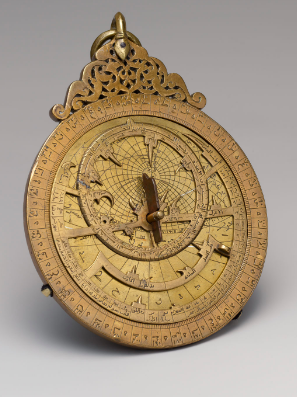
Astronomical instrument, astrolabe, made by astronomer Al-Fazari to determine the exact timings of sunset and sunrise. A tool originally used for determining prayer timings, fasting times, and to assess height and distance for geography. It was later perfected by an intelligent Muslim woman, Merriam al-Ijliyah (Al-Hassani, 238).
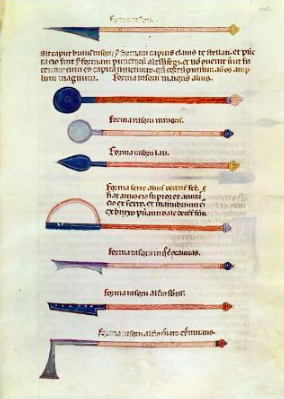
Some of Al-Zahrawi’s medical instrument inventions – many of which are still used today, such as the scalpel and forceps (Al-Hassani, 168).

Works Cited (references)

  1. Ahmad, Khurshid. “What are the basic principles of Islam?” The Faith. 2017. <http://www.the-faith.com/featured-posts/carly-fiorina/&gt;.
  2. Al-Hassani, Salim T.S.. 1001 Inventions: The Enduring Legacy of Muslim Civilizations. 2012. National Geographic, 3rd ed.
  3. Banu Musa and the Science of Tricks. 1001 Inventions, 2018.
  4. Elgohary, Mohamed Amin. “Al Zahrawi: The Father of Modern Surgery.” Annals of Pediatric Surgery. 2006. <http://www.aps.eg.net/back_issue/vol2/issue2_april2006/pdf/1-Al%20Zahrawi.pdf&gt;.
  5. “Historical Biographies: Robert Boyle.” Science History Institute. 01 Dec. 2017. Science History Institute. <https://www.sciencehistory.org/historical-profile/robert-boyle&gt;.
  6. Mansoor, Hammal. “Avicenna’s Influence on Science and Psychology.” Khalil Center. 04 Sept. 2015. http://khalilcenter.com/wp-content/uploads/2017/06/khalilCenter_Side-Blue-300×106.jpg. <https://khalilcenter.com/avicennas-influence-on-science-and-psychology/&gt;.
  7. Masood, Ehsan. Science and Islam: A History. Icon Science, 2017.
  8. Overbye, Dennis. “How Islam Won, and Lost, the Lead in Science.” The New York Times. 30 Oct. 2001. The New York Times. <https://www.nytimes.com/2001/10/30/science/how-islam-won-and-lost-the-lead-in-science.html&gt;.
  9. Sterns, Olivia. “Muslim inventions that shaped the modern world.” CNN. 29 Jan. 2010. Cable News Network. <http://edition.cnn.com/2010/WORLD/meast/01/29/muslim.inventions/index.html&gt;
  10. 1001 Inventions and the Library of Secrets. Produced by Ahmed Salim, performances by Sir Ben Kingsley and others, 1001 Inventions, 2010.